
Saturation character
Each engine enters saturation in its own way, from gentle density to assertive clipping.
Saturation / Harmonic Processor
16 saturation engines. One fast workflow.
Digital flexibility. Analog character.
A powerful saturation processor with 16 distinct analog-inspired modes, fast controls and deep internal flexibility.
Sales are not open yet
Overview
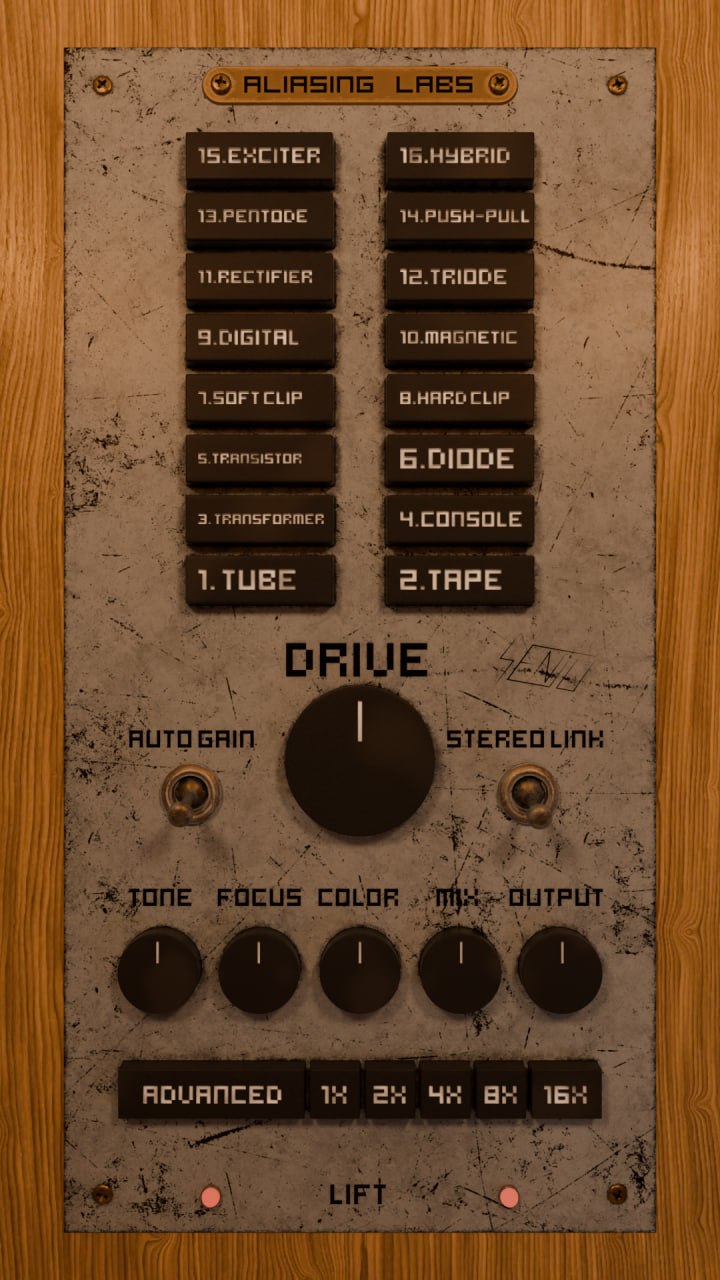
Lift is a universal saturator built around 16 independent DSP models rather than one algorithm with preset control positions.
Every model has its own harmonic structure, dynamic response and overload behavior. The result stays deep and musical without turning the main workflow into a dense multiband system.
Each engine enters saturation in its own way, from gentle density to assertive clipping.
Distinct nonlinear curves shape the balance and movement of generated harmonics.
The models react differently to level, envelope and sustained energy.
Attacks can stay open, become rounded or move forward depending on the selected engine.
Higher Drive settings reveal a different compression and clipping profile in every model.
Core advantages
The control set keeps daily decisions quick while the processing architecture remains flexible under the surface.
Sixteen distinct analog-inspired nonlinear engines, not variations of one preset.
Choose an engine, set Drive, refine the response and keep listening.
Reshapes the model's internal response, harmonic balance and dynamic feel.
Changes which frequency regions drive the nonlinear response most strongly.
Compensates level changes while Drive is adjusted.
Supports fairer comparisons based on perceived loudness.
Quality modes up to 16x reduce unwanted aliasing when needed.
Parallel blending keeps the original signal available at every setting.
Deeper options stay available without crowding the main interface.
The processing range covers subtle density, assertive color and creative distortion.
16 Saturation Engines
Each mode is planned as a separate nonlinear algorithm with its own saturation, harmonic and transient behavior.
Engine names and implementation details may change during development.
Smooth tube saturation, rounded transients and dense musical harmonics.
Gentle peak compression, a rich midrange and softened high frequencies.
Solid low end, expressive mids and transformer-inspired nonlinearity.
Analog channel density, light compression and a more connected sound.
A fast, firmer response with pronounced attack and focused mids.
Distinct nonlinearity ranging from soft saturation to audible overdrive.
Progressive peak control without an abrupt digital edge.
Direct, aggressive clipping for drums, bass, synths and creative effects.
Controlled modern digital nonlinearity for brightness, detail and experimentation.
Core-like magnetic saturation with low-frequency density and dynamic movement.
Asymmetric shaping with a pronounced change in waveform and harmonic balance.
A gentle tube model with a gradual onset and musical harmonics.
A brighter, more forceful tube character with clear presence.
A tighter dual-ended response with controlled dynamics and less asymmetry.
Upper-range harmonic excitation for presence, brightness and intelligibility.
Lift's signature hybrid model combines several nonlinear principles.
Main Controls
A consistent front panel makes sixteen different algorithms feel like one instrument.
Select one of sixteen engines. Only one processing model is active at a time.
Sets the amount of saturation, compression, overdrive or clipping produced by the selected model.
Changes the nonlinear curve, harmonic balance, asymmetry, transient feel and the path into saturation.
Moves the frequency sensitivity from a stronger low-frequency emphasis through an even response to greater high-frequency emphasis.
Provides final tonal shaping after the nonlinear stage.
Blends from the untouched source at 0% to the fully processed signal at 100%.
Sets the final output level after processing.
Smart Workflow
Utility controls make it easier to judge what the nonlinear processing is actually doing.
Automatically compensates level changes while Drive is adjusted.
Matches processed and original signals using perceived loudness rather than peaks alone.
Lets you hear the added harmonics, distortion and dynamic changes separately.
Links left and right channel behavior to keep the stereo image stable.
High-Quality Processing
Choose an efficient working setting or increase processing quality when the material calls for it.
1x, 2x, 4x, 8x and 16x modes trade additional CPU use for lower unwanted aliasing.
Removes DC offset that can appear with asymmetric nonlinear processing.
Controls the quality of internal calculations. Final behavior will be confirmed during development.
Provides a protective output ceiling against unwanted digital clipping; it is not presented as a full limiter.
Advanced Control
The Advanced panel is planned for settings that matter in specific sessions without making everyday operation slower.
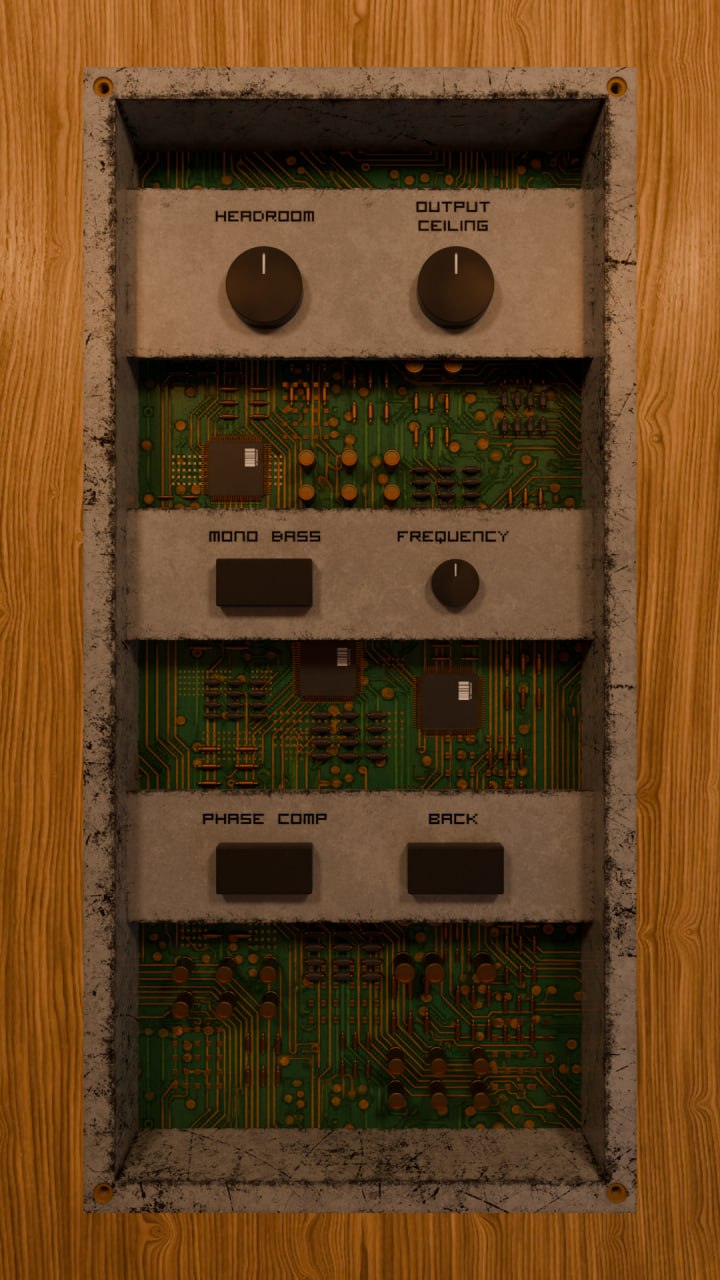
More Headroom keeps the response cleaner for longer; less Headroom reaches density and saturation earlier.
Sets the maximum allowed output level after the processing chain.
Would sum frequencies below a selected point to mono. This feature is under consideration and may not ship in the first version.
Would address potential phase movement and may move to technical settings before release.
Gear Settings
Planned technical settings cover interface scale, quality and repeatable defaults for frequently used processing options.
The final settings list remains subject to release-build validation.
Visual direction
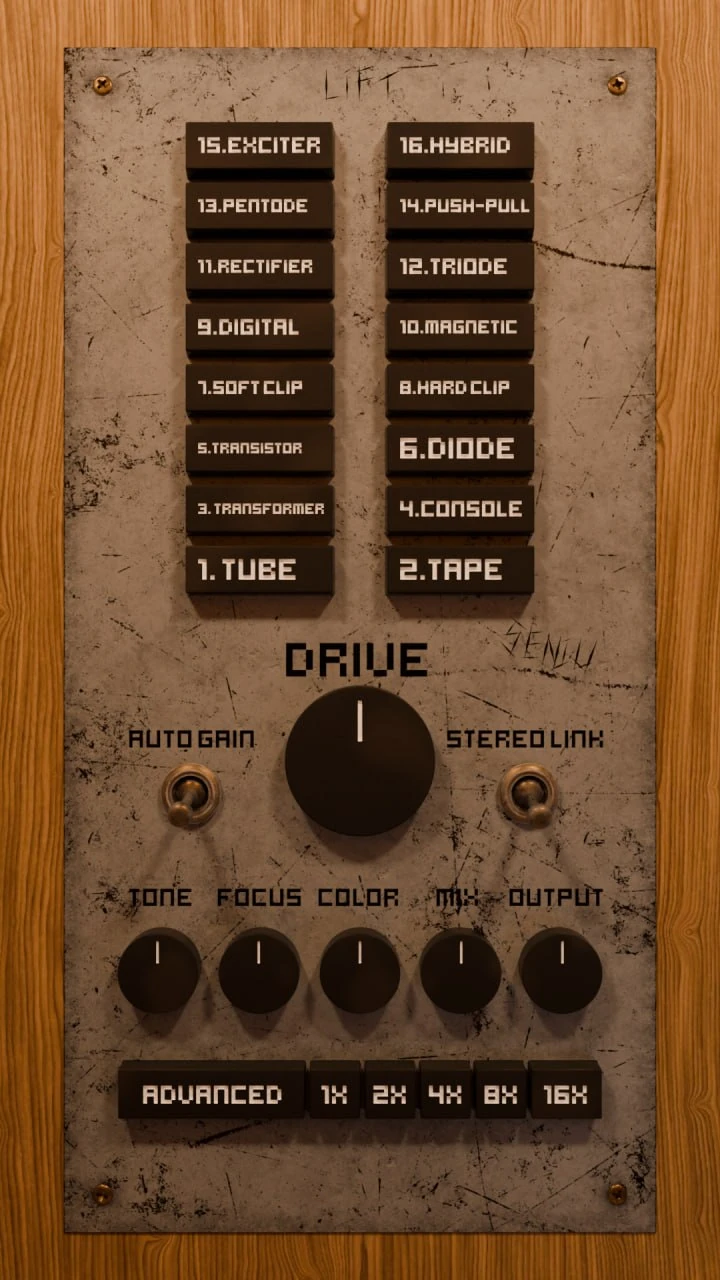
Lift takes inspiration from old apartment elevators across the former Soviet region: worn materials, physical floor buttons, compact lamps and purposeful industrial details.
The final interface will keep that tactile identity readable and fast. This page deliberately avoids presenting a speculative control layout as the finished GUI.
Use Cases
Lift is being designed for subtle harmonic density, audible color and creative nonlinear processing across a full production workflow.
Lift product line
The three processors share one sound-quality standard and differ in range, depth and speed.
Lift One
One premium engine for fast, deliberate saturation without compromises.
Lift Little
Eight independent engines with focused controls and the same processing quality.
Lift
The complete 16-engine processor for the widest harmonic range.
Documentation
View the complete update history, changes and improvements for this plugin.
In development
Shape harmonics, control density and add character without slowing down your workflow.
Sales are not open yet